Approaching a Century of CMV Safety
CMV Safety 1935 — 2035
Our Last Decade Toward a Century of Safety…
By Darin Jones – J3 Safety Leadership, LLC
CMV Safety: From Regulation to Culture
While opinions for improving transportation safety will always be abundant, achieving agreement on the right path forward remains a great challenge. Over our lifetimes, we have witnessed remarkable advancements in commercial motor vehicle (CMV) and traffic safety worldwide—from infrastructure design and safety countermeasures to vehicle standards, driver qualifications, data integration, fatigue management (yes, even hours of service), and advanced driver safety assistance technology.
Many of the most significant CMV safety achievements have emerged within the past 40 years. The deregulation of 1980 opened markets and competition while ushering in new safety programs, regulatory requirements, and national campaigns. These initiatives collectively transformed how regulators and the industry approached safety oversight, compliance, and accountability.
A Foundation Built on Legislative Regulation
Since 1935, each piece of legislation passed by Congress has expanded the scope and depth of CMV safety regulations, programs, and the authorities of the U.S. Department of Transportation (USDOT) and its modal administrations. The 1935 Act itself laid the foundation of the federal safety framework in fewer than 40 pages, divided into three concise parts:
Part I – Qualifications of Drivers
Part II – Driving of Motor Vehicles
Part III – Parts and Accessories Necessary for Safe Operation
Even in those early years, regulators understood the complexity of highway safety. The 1937 rulemaking offered statements that resonate 90-years later:
“Little need be said here of the gravity of the highway-accident problem in the United States for the facts are well known.”
“The task of establishing highway safety regulations on a national scale is not an easy or a simple one.”
“Certain operators have achieved noteworthy results through their own careful control of personnel and equipment, working often in close cooperation with State and municipal regulatory agencies.”
“We recognize that first and foremost in the problem of motor-vehicle safety is the driver, the man at the wheel.”
Even in 1935, the regulation governing driver hours of service (HOS) was deferred for further study—a debate that continues today. The 1937 preamble reflected a practical truth that remains timeless: “No motor vehicle shall be driven by any driver while his ability or alertness is so impaired through fatigue, illness, or any other cause as to make it unsafe… nor shall he be required or knowingly permitted to drive while in such condition, except in case of grave emergency.”
Notably, the early regulators also recognized the importance of communication and situational awareness, requiring “the ability to read and speak the English language… and to understand traffic and warning signs.”
The Evolution of Oversight
In 1966, the Department of Transportation Act created the USDOT, transferring commercial motor vehicle safety oversight from the Interstate Commerce Commission (ICC) to the newly formed department. The Federal Highway Administration (FHWA) was assigned responsibility for CMV safety, with regulations codified in Title 49 CFR, Chapter III, Subchapter B.
From that point forward, every decade brought new legislative acts expanding safety oversight, program mandates, and regulatory sophistication:
40+ Years of Highway Transportation Authorizations
1982 – Surface Transportation Assistance Act (STAA)
1991 – Intermodal Surface Transportation Efficiency Act (ISTEA)
1998 – Transportation Equity Act for the 21st Century (TEA-21)
2005 – Safe, Accountable, Flexible, Efficient Transportation Equity Act (SAFETEA-LU)
2012 – Moving Ahead for Progress in the 21st Century (MAP-21)
2015 – Fixing America’s Surface Transportation Act (FAST Act)
2021 – Infrastructure Investment and Jobs Act (IIJA) aka Bipartisan Infrastructure Law (BIL)
Other Significant CMV Safety Legislation
1984 – Motor Carrier Safety Act (MCSA)
1986 – Commercial Motor Vehicle Safety Act (CMVSA)
1995 – ICC Termination Act
1999 – Motor Carrier Safety Improvement Act (MCSIA)
Among these, three stand out as turning points in closing out the 20th century:
1984 – Motor Carrier Safety Act: Established the commercial motor vehicle definition at 10,001 lbs. or more and required the development of safety fitness ratings, controlled substance testing, and safety fitness determinations—cornerstones still in use today.
1986 – Commercial Motor Vehicle Safety Act: Created the Commercial Driver’s License (CDL) program, standardizing testing and licensing nationwide under the principle of “one license, one record.”
1999 – Motor Carrier Safety Improvement Act: Established the Federal Motor Carrier Safety Administration (FMCSA), focusing federal resources on reducing CMV crashes, injuries, and fatalities through targeted safety programs and partnerships.
Ninety Years of Progress & Persistent Challenges
Over the past nine decades, we’ve seen extraordinary advances in traffic safety and technology. Yet despite these gains—and the countless regulations, enforcement programs, and innovations—we continue to see preventable deaths, injuries, and societal costs rise from traffic crashes on our roads.
During my 39-years studying, working, and leading people on CMV safety programs—audits, investigations, civil penalty adjudications, policy development, and collaborating with industry and state officials—I’ve observed the full spectrum of carrier operations. Those who embrace safety as a core value and cultivate a safety culture, to chronic violators who reappear under new names and DOT numbers, continuing their blatant disregard for safety. I’ve also witnessed the frustration of dedicated enforcement officials constrained by limited resource and tools, as they struggle to keep pace with a rapidly growing industry and the persistent challenge of habitual unsafe operators.
It became clear long ago that enforcement alone cannot deliver long-term success in crash reduction and safety compliance. True progress depends on collaboration among all stakeholders—Regulators (federal, state, local, and tribal); Industry (carriers, drivers, brokers, shippers, and associations); Transportation affiliates (employers, emergency responders, insurers, and technology innovators); and System users (the public).
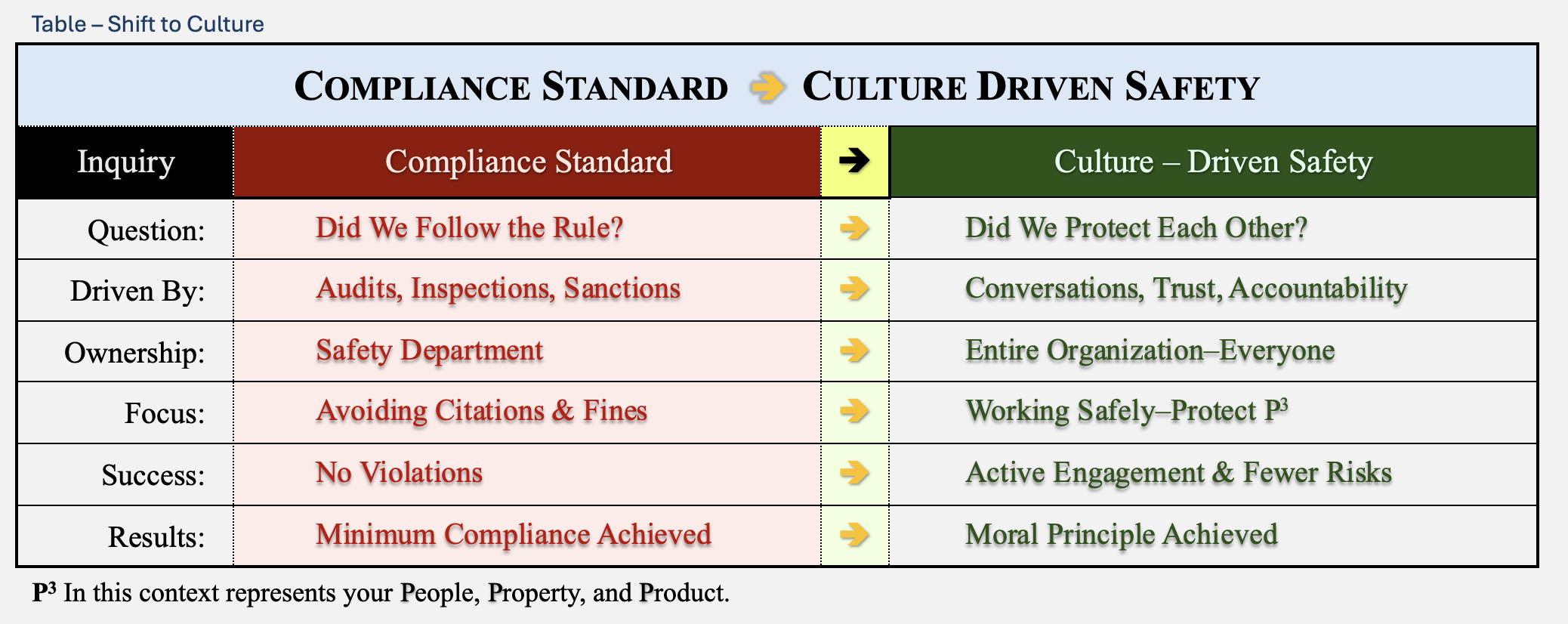
Only through shared ownership can we move from a compliance-based minimalist mindset—focused on “what’s required”—to a principled culture-based mindset, focused on “what’s right.”
The Challenge: Moving Beyond Minimum Compliance
In a highly regulated industry, it’s easy for safety to become about rules, checklists, and sanctions. Yes, compliance is essential—it sets the minimum standard for lawful operation. But “minimum” compliance does not guarantee safety; it simply avoids adverse actions or sanctions.
A true safety culture goes further. It ensures that the right choice becomes the only choice—instinctive, consistent, and value-driven. Every employee, whether in a carrier’s office, a shipper’s dock, or behind the wheel, must own every safety decision they make. Leadership at every level must model this accountability and build an environment where safety is not expected—it’s embedded.
How We Create Safety Culture Beyond Safety Compliance
Creating a lasting safety culture requires more than compliance—it requires conviction. Regulations, rules, and enforcement provide the structure for safe operations, but they cannot alone build the mindset that truly sustains safety. That mindset is born from shared values, consistent leadership, and everyday decisions made by people who care about protecting one another. Building a safety culture beyond compliance means shifting our focus from what we have to do, to what we choose to do—because it’s the right thing to do. It’s about moving from obligation to ownership, from checking boxes to taking personal responsibility for making safe choices and practicing safe behaviors every day.
The following principles outline how organizations can bridge that gap—transforming safety from a regulatory requirement into a living, breathing part of their identity.
· Reframe Safety as a Core Value – Regulations define the minimum standard, but our commitment to safety defines who we are. Safety is not a rule we follow—it’s a value we live. Our standard must always be measured in lives protected, not penalties avoided.
· Lead by Example – Leadership sets the tone for culture. Every leader—from executives to frontline supervisors—must demonstrate safe behaviors and foster open dialogue by asking, “Do you feel safe?” When leaders model safety as a priority, it becomes permission for everyone to do the same.
· Empower Every Employee – A strong safety culture thrives when every person feels responsible for preventing harm. Empowerment means every employee has both the right and the duty to stop unsafe work. Reporting hazards, identifying risks, and offering solutions should be celebrated as acts of leadership, not viewed as interruptions.
· Focus on Proactive Culture Metrics – True progress comes from measuring what prevents harm, not just what happens after it occurs. We must look beyond lagging indicators like incident rates and instead track engagement, near-miss reports, and proactive hazard identification. These are the real signs of an active, embraced safety culture.
· Tell Human Stories – Statistics may inform us, but stories move us. Sharing real examples—how a quick decision, a safety check, or a moment of courage prevented tragedy—reminds everyone that safety is deeply personal. Every policy, process, and choice ultimately impacts people, families, and communities.
· Integrate Safety Ownership into Everyday Work – Safety cannot exist as a separate agenda item or a quarterly topic—it must be woven into every meeting, plan, and task. When safety becomes part of daily conversation and decision-making, it ceases to be a program and becomes a habit—a natural, automatic part of how we operate.
The Next Decade’s Opportunity
For 90-years, CMV safety has been defined by regulation, inspection, and enforcement. The next decade presents a new opportunity—to define it through collaboration, innovation, and culture. A regulatory agency can enforce compliance, but it cannot enforce beliefs, principles, or values. The power to build a safety culture resides within every organization, every leader, every manager, every driver, and every employee—each making a conscious choice to prioritize safety when drafting policies, issuing directives, making decisions, and engaging with clients.
Key Take-Away
Regulations establish the minimum safety requirements for operating as a regulated entity—whether as a truck, bus, or hazardous materials motor carrier. But the future of safety will be defined not by what the rules require, but by why we choose to operate safely—by leaders, drivers, and every transportation stakeholder taking ownership of safety as professional responsibility and a personal moral value. While autonomous trucks may one day promise safer operations, it will take decades before they are fully integrated across the industry. When safety becomes a shared value—not just a regulation—we not only achieve compliance, but protect people, build trust, create long-term success, and most importantly save lives.